
No Generative AI Model Will Ever Understand the Way Humans Do
AI systems pose credible risks primarily as amplifiers of human actions, rather than from developing self-agency and going rogue.

"It's very possible that humanity is just a phase in the progress of intelligence. Biological intelligence could give way to digital intelligence. After that, we're not needed. Digital intelligence is immortal, as long as its stored somewhere." Geoffrey Hinton, a Godfather of AI
"I think it's an open question as to whether they have genuine understanding or not...But they clearly have some form of understanding that is quite different from the way humans understand things." Geoffrey Hinton, a Godfather of AI
“Large language models may have developed a type of "constitutive understanding" through their training process, even if different from human conceptual understanding.” Ilya Sutskever, ex OpenAI
This article explains why I disagree with Geoffrey Hinton's perspective. I have never found his idea about AI going rogue intuitively convincing from various angles, including philosophical ones, but here I will focus solely on the technical aspects.
Generative AI has made remarkable strides in recent years, dazzling us with its ability to produce lifelike images and coherent text. However, it is crucial to recognize that these models, despite their sophistication, do not and cannot understand content the way humans do. This article explores why generative AI, while impressive, falls short of true comprehension and meaning.
The Fundamental Differences Between Image and Text Generation
Generative AI models are designed to create content, but the processes for generating images and text are fundamentally different. Image generation typically relies on algorithms like Generative Adversarial Networks (GANs) or diffusion models. These models excel at recognizing patterns in visual data, such as shapes, colors, and textures, and then using this information to create images that fit a given description. This process, however, does not require an understanding of the context or meaning behind the images.
Text generation, on the other hand, is a more complex task. It requires a deep understanding of language, grammar, syntax, and semantics to produce coherent and meaningful sentences. Unlike images, which are made up of pixels arranged in a grid, text is a sequence of characters or words that form hierarchical relationships. The meaning of a text depends heavily on these structures and the context in which words are used. This complexity makes text generation a more challenging task for AI.
The Role of Different Algorithms
The algorithms used for image and text generation reflect these fundamental differences. GANs and diffusion models are well-suited for the 2D grid structure of images, where they can gradually transform random noise into coherent images through pattern recognition. In contrast, text generation relies on Transformer models, a type of neural network architecture that excels in natural language processing tasks. Transformers use self-attention mechanisms to analyze relationships between words in a sentence, enabling them to generate contextually appropriate and coherent text.
However, despite the success of Transformers in text generation, they still do not "understand" text in the way humans do. They can mimic patterns and structures found in large datasets of text, but they lack true comprehension of the meaning behind the words.
Efforts to Combine Image and Text Generation
Researchers have attempted to combine both approaches to create models capable of generating both images and text. One notable example is OpenAI's DALL-E, which uses a variant of the Transformer model to generate images from textual descriptions. DALL-E's architecture combines the strengths of both image and text generation models by leveraging the Transformer’s ability to understand and generate text while using techniques from image generation to create coherent visuals.
While DALL-E has achieved impressive results, demonstrating the ability to generate highly detailed and contextually appropriate images from complex textual prompts, it still faces limitations. The model can create images that match the description well, but the generated images often lack the nuanced understanding that a human artist would bring to the same task. Similarly, the text descriptions used to generate images must be clear and detailed, as the model's output can be significantly less accurate with vague or ambiguous prompts.
Another effort is Google’s Imagen, which also uses diffusion models combined with textual input to generate images. Imagen shows strong performance in producing high-quality images that align closely with the provided text. However, like DALL-E, it does not truly understand the content but rather follows patterns it has learned during training.
These combined models represent significant advancements in AI, bridging the gap between image and text generation. The research is of course continuing to advance: A multimodal approach that combines text and image data during training has been been found to be helpful in improving the performance of generative AI models. By training a model on both text and image data, it can learn to recognize patterns and relationships between different types of information, and use that knowledge to produce more coherent and meaningful output. I imagine we will even see multimodal models with a latent space that captures not only text and image but everything else including sound, haptics(virtual touch) and even taste.
However, they still highlight the fundamental issue: while these models can simulate understanding and produce impressive outputs, they do not possess genuine comprehension.
The Limitations of Generative AI
One common observation with generative AI is its tendency to produce content that appears coherent at a superficial level but lacks deeper meaning or coherence. For instance, an AI might generate an image where a word is spelled correctly in one part and incorrectly in another. This inconsistency highlights the model's lack of understanding. It recognizes the visual patterns associated with the word but does not grasp its meaning or how it should be consistently used.
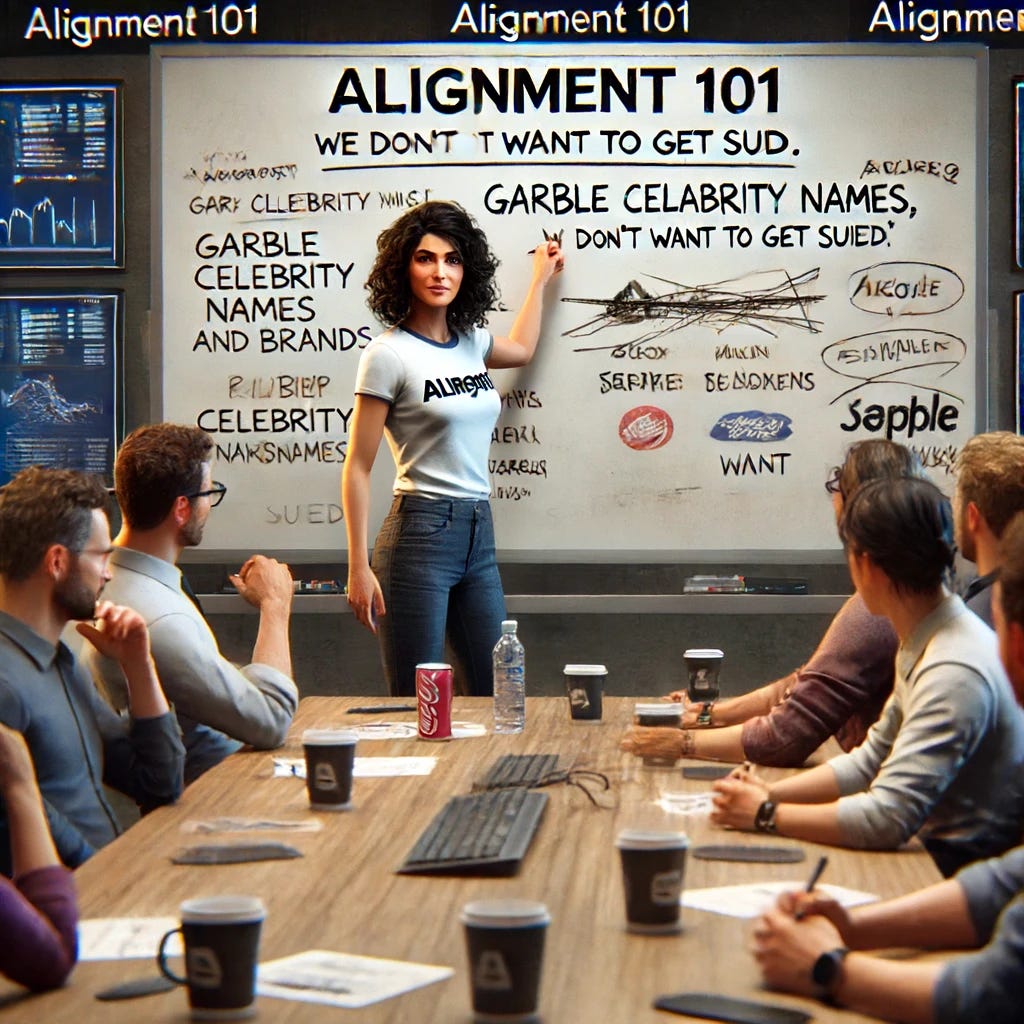
This limitation extends to text generation as well. While a Transformer model might produce text that uses words and phrases commonly associated with a particular topic, it does not understand the deeper meaning or implications of those words. The AI is essentially mimicking patterns without comprehending the content it is producing.
The Illusion of Understanding
It is essential to approach AI-generated content with a critical eye. The sophistication of generative AI models can create the illusion of understanding, but this is not the case. Even if additional layers are added to correct superficial errors, such as spelling mistakes in AI-generated images, this does not change the fundamental lack of comprehension. The AI does not understand the "perfect" content it produces; it simply follows learned patterns.
The Human Touch
As generative AI continues to advance, its output will become more convincing. However, it is crucial to remember that true understanding and creativity still require a human touch. Generative AI models are powerful tools that can assist in various tasks, but they should not be relied upon as a replacement for human comprehension and insight.
Conclusion: Viewing AI as Allies, Not Autonomous Agents
It is wiser to view AI systems as allies that support our cognition rather than as beings with innate or emerging agency. Generative AI, no matter how advanced, lacks the organic understanding that humans possess. While it is possible to build additional layers that simulate agency, this simulated agency is not genuine. It is implanted by humans with specific agendas and programming.
In the end, we might be convinced that an AI system understands because it can perfectly simulate understanding, passing undetected. However, this would be a simulation rather than true comprehension. Therefore, recognizing the role of AI as a supportive tool rather than an autonomous entity is crucial. By doing so, we can harness the power of AI to augment human capabilities without falling into the trap of attributing it with a level of understanding it does not possess. This approach ensures that we maintain a clear perspective on the limitations and appropriate uses of AI technology.
For all practical purposes, it is true that many, if not most, people will start considering these robots as living entities on par with human lives. These AI systems will undoubtedly impact our psychology, relieve us from loneliness, replace partners, and improve our quality of life. They might even manufacture themselves and provide explanations as effectively as the best experts and teachers on the planet. However, this does not mean they have developed true understanding. Their ability to simulate understanding perfectly may convince us otherwise, but this is a façade of comprehension, not the real thing.
Thus, while these AI systems are indeed allies, they should not be mistaken for beings with genuine understanding. Recognizing this distinction is essential for responsibly integrating AI into our lives and reaping its benefits without being misled by its superficial capabilities.
#GenerativeAI #AIUnderstanding #AIVsHumanComprehension #AITextGeneration #ImageGenerationAI #GANs #TransformersAI #AIAlgorithms #AIlimitations #ArtificialIntelligence #AIandHumans #AIPatternRecognition #AIContentCreation #AICompanion #AIAgency #SimulatedUnderstanding #AIandPsychology #AIInOurLives #HumanAIInteraction #AIFuture